

Fresh news on healthcare in the world
Provided by AGP
ALERT: PHONE SCAMS TARGET NURSES AND MEDICAL PROFESSIONALS STATEWIDE
STATE OF HAWAIʻI
KA MOKU ʻĀINA O HAWAIʻI
JOSH GREEN, M.D.
GOVERNOR
KE KIAʻĀINA
DEPARTMENT OF COMMERCE AND CONSUMER AFFAIRS
KA ʻOIHANA PILI KĀLEPA
NADINE Y. ANDO
DIRECTOR
KA LUNA HOʻOKELE
PROFESSIONAL AND VOCATIONAL LICENSING DIVISION
CINDY A. MATSUSHITA
LICENSING ADMINISTRATOR
ALERT: PHONE SCAMS TARGET NURSES AND MEDICAL PROFESSIONALS STATEWIDE
FOR IMMEDIATE RELEASE
May 13, 2026
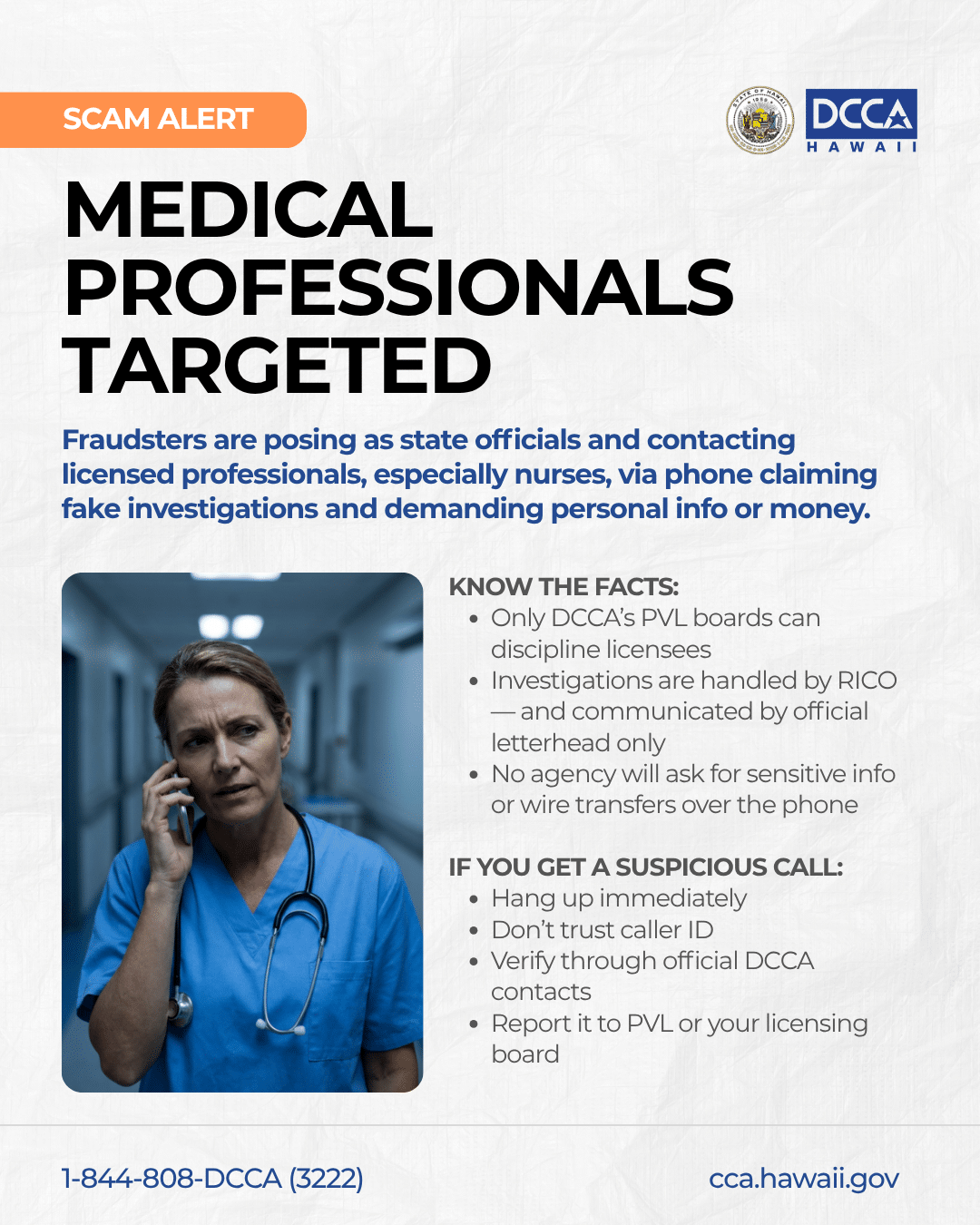
HONOLULU — The Department of Commerce and Consumer Affairs (DCCA) is warning medical professionals — particularly nurses — about an active phone scam in which fraudsters impersonate state officials.
Specifically, individuals posing as state officials are contacting current and former nursing licensees — including LPNs, RNs and APRNs — and falsely claiming that an investigation has been opened against them. Scammers may request personal information or, in some cases, solicit wire transfers. While recent incidents have primarily targeted nursing professionals, dental professionals, pharmacists and other medical licensees have also been targeted and remain at risk.
Understanding how legitimate DCCA agencies operate can help prevent being the victim of a scam. Here are a few tips to remember:
- Only the 52 licensing boards, commissions and programs attached to the DCCA’s Professional and Vocational Licensing (PVL) division have authority to discipline a professional license. Discipline occurs only after proper notification to the subject and investigation by the Regulated Industries Complaints Office (RICO).
- Like the PVL, RICO is an independent agency within the DCCA that performs investigative and prosecutorial functions only. During the course of an investigation, RICO communicates with subjects in writing through official letterhead only. RICO investigators will never ask for sensitive personal information over the phone or request wire transfers.
- Other state departments, such as the Departments of Health or Human Services, have no authority to suspend, revoke, or investigate a professional license issued by one of the 52 boards, commissions and programs under the PVL division of the DCCA.
What to Do If You Receive a Suspicious Call
- Hang up immediately without providing any personal information.
- Do not rely on caller ID — scammers can spoof official government numbers.
- Verify independently by contacting the agency directly using a phone number from the official DCCA website: https://cca.hawaii.gov/pvl/contact/
- Report the call to your respective licensing board, or contact PVL directly at 1-844-808-3222 Extension #1.
A full list of licensing programs and contact information for each are available at https://cca.hawaii.gov/pvl/.
Impersonating a public servant is a criminal offense and will be investigated and prosecuted.
PR Scam Phone Calls Nurses.png
###
Legal Disclaimer:
EIN Presswire provides this news content "as is" without warranty of any kind. We do not accept any responsibility or liability for the accuracy, content, images, videos, licenses, completeness, legality, or reliability of the information contained in this article. If you have any complaints or copyright issues related to this article, kindly contact the author above.
