

Mechanical Ventilators Market to reach USD 9.52 Billion by 2035 at 5.3% CAGR
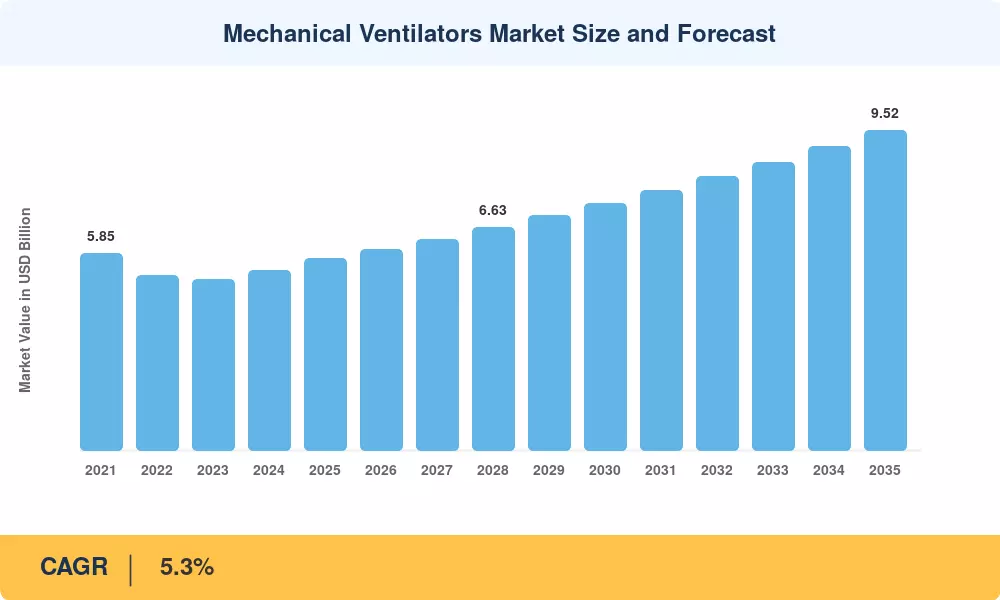
Mechanical Ventilators Market Size
Mechanical Ventilators Market to Grow from USD 5.98 Billion in 2026 to USD 9.52 Billion by 2035-By Aging Populations and Prolonged ICU Stays
NY, CA, UNITED STATES, July 20, 2026 /EINPresswire.com/ -- As per Market Research Future, the global Mechanical Ventilators Market size is projected to reach USD 9.52 Billion by 2035 from USD 5.98 Billion in 2026, at a CAGR of 5.3% during the forecast period 2026–2035. The market base was estimated at USD 5.70 Billion in 2025.The 5.3% CAGR—anchored by structural respiratory-care demand rather than discretionary healthcare spending—is driven by three converging forces: aging global populations that continue to widen the addressable base for prolonged ICU stays, sustained adoption of AI-enabled closed-loop ventilation platforms that have pulled legacy single-mode devices toward multi-modal systems capable of real-time patient–ventilator synchrony analysis, automated weaning protocols, and cloud-based remote monitoring, and the technological shift from purely clinician-directed modes toward autonomous, self-adjusting platforms that reduce median ventilation duration by 1.5 days and lower reintubation rates by 22% compared to standard protocol-based weaning.
National governments and multilateral health organizations are amplifying this momentum. The WHO estimates that over 500 million people globally live with chronic obstructive pulmonary disease, a figure that expands critical-care admissions year after year. The U.S. Centers for Medicare & Medicaid Services expanded coverage of home ventilation therapy in 2024, unlocking an estimated USD 1.2 billion in addressable spending over the next five years. India's National Health Mission allocated INR 64,000 crore (approximately USD 7.6 billion) for hospital infrastructure modernization through 2028, with dedicated funding tranches for ICU ventilator procurement in district-level hospitals. China's 14th Five-Year Plan for healthcare targets adding 120,000 ICU beds by 2027 across tier-2 and tier-3 cities. Together, these initiatives are creating the procurement infrastructure and ventilation innovation ecosystem on which the Mechanical Ventilators Market depends.
Request A Free Sample:
https://www.marketresearchfuture.com/sample_request/9714
Key Market Trends & Growth Drivers
Aging Populations and Prolonged ICU Stays
The global population aged 65 and older is expected to reach 1.6 billion by 2050, according to UN projections, with the steepest growth in East Asia and Western Europe. Older patients require mechanical ventilation at disproportionately high rates—Medicare data indicates that patients over 75 account for 38% of all ventilator-days in U.S. hospitals despite representing just 14% of ICU admissions. This demographic shift translates directly into sustained demand for the Mechanical Ventilators Market, as hospitals plan capacity around the rising average length of stay in critical-care units. Each percentage point of aging-population growth translates into measurable ventilator volume, and the prolonged ICU stay embedded in routine geriatric critical care makes this driver structurally durable through 2035.
Japan's super-aging society and Germany's dense network of tertiary-care hospitals anchor regional demand for high-acuity ventilator platforms. China's rapidly expanding elderly population and India's growing burden of chronic respiratory disease are creating regional demand centers that did not exist a decade ago.
AI-Enabled Closed-Loop Ventilation Platforms
Artificial intelligence is transforming ventilator design from reactive alarm-based systems to proactive, self-adjusting platforms. Clinical trials published in The Lancet Respiratory Medicine demonstrated that AI-driven automated weaning reduced median ventilation duration by 1.5 days and lowered reintubation rates by 22% compared to standard protocol-based weaning. These measurable outcomes are compelling hospital networks to accelerate fleet upgrades, with the American Hospital Association reporting that 41% of U.S. health systems had allocated capital budgets for smart ventilator procurement by mid-2025. Legacy single-mode devices are being replaced by multi-modal systems capable of real-time patient–ventilator synchrony analysis, automated weaning protocols, and cloud-based remote monitoring.
Pooled procurement through group purchasing organizations drives per-unit prices down by 15–25% in high-volume tiers, expanding access while compressing manufacturer margins. GPOs negotiate volume-based contracts that typically reduce per-unit ventilator prices by 15–25% compared to list pricing. Buyers should evaluate whether GPO agreements include software upgrade commitments and multi-year service coverage before signing.
Home Ventilation Reimbursement Expansion
Updated CMS guidelines, effective January 2025, broadened Medicare Part B coverage for home non-invasive ventilation to include patients with chronic respiratory failure secondary to neuromuscular disease, obesity hypoventilation syndrome, and severe COPD. The policy change removed prior-authorization barriers for an estimated 320,000 eligible beneficiaries in the first year alone. Manufacturers with established durable medical equipment distribution networks stand to capture a disproportionate share in this rapidly expanding segment of the Mechanical Ventilators Market.
The CMS Acute Hospital Care at Home (AHCAH) initiative has approved 366 hospitals across 139 health systems as of early 2026, with legislative extension of these waivers through September 2030 providing the regulatory certainty required for sustained, long-term medical device procurement. As per-device costs fall with scale and reimbursement parity legislation expands, the addressable channel widens from hospital ICUs to long-term care facilities, home healthcare agencies, and ambulatory surgical centers, extending mechanical ventilators beyond traditional settings.
Ask for Customization:
https://www.marketresearchfuture.com/ask_for_customize/9714
Market Segment Insights
BY MOBILITY
Intensive Care Ventilators: Dominant segment with ~50% revenue share in 2025. Reflecting entrenched hospital-based demand for high-acuity devices with the broadest range of ventilation modes, integrated monitoring, and data connectivity features demanded by tertiary hospitals. Medtronic and Dräger anchor this segment.
Portable Ventilators: Fastest-growing mobility category at 5.7% CAGR (2026–2035). Driven by prehospital emergency medical services modernization and home-care reimbursement expansion. Compact, battery-operated platforms capable of delivering both invasive and non-invasive support across diverse clinical environments. Philips and ResMed lead expansion.
Transport Ventilators: USD 0.63 Billion in 2025. Inter-facility patient transfers and air-ambulance services sustain demand for ruggedized, lightweight platforms.
BY INTERFACE
Invasive Ventilation: Dominant interface with ~59% revenue share in 2025. Reflecting the clinical necessity of endotracheal intubation for patients with severe respiratory compromise in ICU settings. Acute respiratory failure management anchors structural demand.
Non-Invasive Ventilation: Fastest-growing interface at 6.0% CAGR (2026–2035). Clinical evidence increasingly supports use for early-stage respiratory failure, post-extubation support, and chronic disease management in home settings. Reimbursement expansion across North America and Europe accelerates adoption.
BY PATIENT AGE
Adult: Dominant patient segment with ~65% revenue share in 2025. The largest patient population base, with higher disease prevalence and ICU admission rates among older populations driving structural demand.
Neonatal: Fastest-growing patient segment at 6.2% CAGR (2026–2035). Government investments in neonatal intensive care capacity across Asia-Pacific and South America. Specialized devices with volume-guarantee and high-frequency oscillatory capabilities command premium pricing in this underserved segment. Getinge and Fisher & Paykel anchor this segment.
Pediatric: USD 0.91 Billion in 2025. Specialized pediatric ICU capacity growth sustains steady demand.
BY END USER
Hospitals: Dominant end user with ~68% share in 2025. National hospital procurement through ministries of health and GPO tenders dominates volume, channeling acute-care ICU infrastructure supply.
Home Healthcare: Fastest-growing end-user segment at 6.4% CAGR (2026–2035). Expanded Medicare coverage, patient preference for treatment outside institutional settings, and the availability of ICU-life-support ventilators redesigned for home use with simplified interfaces and cellular-connected remote monitoring capabilities drive expansion.
Ambulatory Surgical Centers: USD 0.23 Billion in 2025. Outpatient procedural volume growth sustains demand for compact, versatile platforms.
Long-Term Care Facilities: Growing at 4.8% CAGR. Post-acute discharge protocols and step-down care create incremental demand.
BY APPLICATION
Emergency Care: Dominant application with ~42% share in 2025. Trauma, acute respiratory failure, and cardiac arrest management drive structural demand in hospital emergency departments and prehospital settings.
Chronic Respiratory Diseases: Fastest-growing application at 6.1% CAGR (2026–2035). COPD, neuromuscular disease, and obesity hypoventilation syndrome create long-term home ventilation demand as reimbursement policies broaden device eligibility.
Anesthesia: USD 0.78 Billion in 2025. Operating-room ventilation during surgical procedures sustains steady institutional demand.
Neonatal Care: Growing at 5.9% CAGR. NICU capacity expansion and premature birth management protocols drive specialized ventilator placement.
Read Detailed Insights:
https://www.marketresearchfuture.com/reports/mechanical-ventilators-market-9714
Regional Outlook
North America — Dominant Market (~39% Share, 2025)
The United States generates approximately 82% of North American Mechanical Ventilators Market revenue, driven by the highest per-capita ICU bed density among large economies, robust private insurance coverage for critical-care devices, and CMS policy changes broadening home ventilation eligibility. The 2024 expanded home ventilation coverage rule under Medicare Part B converted a hospital-dominated market into one with a structural home-care tail. Reimbursement breadth and AI adoption support premium-priced closed-loop ventilation demand that emerging-market regions cannot match.
Canada is growing at 5.1% CAGR on provincial ICU modernization programs following pandemic-era capacity reviews, contributing 12.5% of regional share. Mexico contributes USD 0.10 Billion on IMSS hospital procurement growth across its network of 1,500+ hospitals, representing the region's highest-growth opportunity. North America's leadership rests on ICU bed density, reimbursement depth, and the structural shift toward AI-augmented and home-based ventilation.
Europe — Second Largest (~28% Share, 2025)
Europe's Mechanical Ventilators Market reflects divergent national strategies under a harmonizing regulatory umbrella. Germany anchors regional demand with 24% of European share, driven by its deep medical-technology manufacturing base, high ICU utilization rates, and Dräger's home-market advantage. The UK is growing at 5.2% CAGR on the NHS Long Term Plan targeting a 25% increase in critical-care bed capacity by 2030, directly expanding ventilator procurement pipelines.
France contributes USD 0.19 Billion on AP-HP fleet refresh programs. Italy is growing at 4.8% CAGR on post-pandemic ICU investment. Spain contributes USD 0.11 Billion on SNS hospital network modernization. The Nordic countries are growing at 5.0% CAGR on home ventilation adoption leadership. Harmonization pressure from EU MDR requirements—compelling manufacturers to upgrade existing product registrations and triggering replacement orders across hospital networks—is gradually narrowing national differences, lifting baseline demand across the region. Russia contributes USD 0.08 Billion on state-funded import substitution programs. The rest of Europe contributes 18% of regional revenue on varied regulatory environments.
Asia-Pacific — Fastest-Growing Region (6.9% CAGR, 2026–2035)
Asia-Pacific is the engine of the Mechanical Ventilators Market. China holds the largest regional share at 35%, with the central government committing to adding 120,000 ICU beds by 2027 across tier-2 and tier-3 cities under the 14th Five-Year Plan for healthcare. India is growing at 7.8% CAGR on the National Health Mission allocating INR 64,000 crore (approximately USD 7.6 billion) for hospital infrastructure modernization through 2028, with dedicated funding tranches for ICU ventilator procurement in district-level hospitals.
Japan contributes USD 0.21 Billion on super-aging population and technology leadership. South Korea is growing at 6.5% CAGR on universal healthcare system expansion. ASEAN economies contribute USD 0.14 Billion on public hospital modernization across Thailand, Indonesia, and Vietnam. The rest of Asia-Pacific is growing at 5.9% CAGR on broad infrastructure development. The region's combined contribution anchors the global volume base for critical-care infrastructure and cost-effective ventilator platform demand.
Middle East & Africa — Emerging Opportunity (5% Share, 2025)
The Middle East & Africa carries the widest critical-care infrastructure gap and therefore significant opportunity. Saudi Arabia leads the region with 30% share, with Vision 2030 channeling significant capital into hospital construction and medical device procurement, making the kingdom the region's largest contributor to the Mechanical Ventilators Market. The UAE is growing at 5.8% CAGR on medical tourism infrastructure expansion, with private hospital groups investing in ICU infrastructure.
South Africa contributes USD 0.04 Billion on NHI rollout plans. Egypt is growing at 6.2% CAGR on population growth driving ICU demand. The rest of MEA contributes 35% of regional revenue on international aid and multilateral financing. Multilateral organizations such as the African Development Bank and the WHO continue to fund ventilator procurement programs for public health systems operating with critical equipment shortages. Capital cost barriers remain a restraint—a single high-acuity ICU ventilator with full monitoring integration carries a list price between USD 25,000 and USD 50,000, placing significant strain on hospital capital expenditure plans, particularly in public healthcare systems operating under fixed annual budgets.
Competitive Landscape and Recent Developments
The Mechanical Ventilators Market exhibits medium concentration, with an estimated Herfindahl-Hirschman Index in the 1,200–1,500 range and the top five players collectively holding an estimated 55–62% of global revenue. Concentration is highest in high-income segments where ventilation mode breadth, AI integration capabilities, service network coverage, and pricing strategies tailored to public-tender-dominated procurement cycles create steep barriers; the emerging-market tier is more fragmented as regional producers compete on price.
The competitive landscape is stratified between full-spectrum critical-care platform leaders serving hospital ICU markets, home-ventilation specialists capturing reimbursement-driven non-invasive growth, and neonatal-focused manufacturers consolidating the underserved pediatric segment.
KEY COMPANIES AND RECENT MILESTONES
Medtronic plc (March 2024): Received FDA 510(k) clearance for an AI-powered weaning protocol module integrated into the Puritan Bennett 980 platform, marking the first FDA-cleared autonomous weaning feature for adult ICU ventilation. Broad critical-care portfolio and global distribution anchor a leadership position. Estimated revenue share: ~12–16%.
Philips Healthcare (2024–2025): Trilogy Evo and V60 Plus anchor a strong home-care and non-invasive segment position. Estimated revenue share: ~10–14%.
Drägerwerk AG (2024–2025): Evita V800 and Savina 300 anchor ICU ventilation technology leadership with an EU manufacturing base. Estimated revenue share: ~9–13%.
Hamilton Medical AG (2024–2025): Hamilton G5 and Hamilton C6 anchor AI-driven Adaptive Support Ventilation pioneer positioning. Estimated revenue share: ~7–10%.
Future Outlook: 2026–2035
By 2030, autonomous ventilation and AI-driven critical care will become the operating system of mechanical ventilator delivery. Artificial intelligence will progressively automate ventilator management across the next decade. By 2030, an estimated 55% of new ICU ventilator installations globally will feature closed-loop automation capable of independently adjusting tidal volume, respiratory rate, and FiO2 based on continuous physiological feedback.
This shift reduces clinician workload during staffing shortages and improves patient outcomes, fundamentally reshaping demand within the Mechanical Ventilators Market. Real-time AI diagnostic feedback creates a data asset that manufacturers can monetize through subscription-based software updates and predictive maintenance contracts, creating a new business model layered on top of the core hardware franchise.
More Related Research Insights:
https://www.marketresearchfuture.com/reports/graft-versus-host-disease-market-32316
https://www.marketresearchfuture.com/reports/h1n1-vaccination-market-40991
https://www.marketresearchfuture.com/reports/haematologic-malignancies-treatment-market-42432
https://www.marketresearchfuture.com/reports/handheld-marijuana-medical-vaporizer-market-37332
https://www.marketresearchfuture.com/reports/handheld-ultrasound-scanners-market-24382
https://www.marketresearchfuture.com/reports/healthcare-application-to-person-sms-market-35811
https://www.marketresearchfuture.com/reports/healthcare-cloud-infrastructure-market-29589
https://www.marketresearchfuture.com/reports/healthcare-data-monetization-solution-market-41124
https://www.marketresearchfuture.com/reports/healthcare-fluid-connector-market-29716
https://www.marketresearchfuture.com/reports/healthcare-mobile-robot-market-37931
Larry Wilson
WantStats Research And Media Pvt. Ltd.
+1 855-661-4441
email us here
Visit us on social media:
LinkedIn
Facebook
YouTube
X
Legal Disclaimer:
EIN Presswire provides this news content "as is" without warranty of any kind. We do not accept any responsibility or liability for the accuracy, content, images, videos, licenses, completeness, legality, or reliability of the information contained in this article. If you have any complaints or copyright issues related to this article, kindly contact the author above.
