

Lab Secondary‑Antibody Selection Guide: Cloud‑Clone Shares Tips for Efficient Reagent Matching
Expert Tips on Secondary‑Antibody Selection: Avoid Common Pitfalls for Reliable Immunoassay Outcomes
HUSTON, TX, UNITED STATES, August 10, 2026 /EINPresswire.com/ -- In life science research, the selection of experimental reagents directly determines the accuracy and efficiency of research outcomes. As a core auxiliary reagent for immunoassays, secondary antibodies undertake signal amplification and labeling functions. Their proper selection exerts a decisive influence on assay sensitivity, specificity and result reliability, serving as a key factor to boost experimental success rates. This article sorts out systematic secondary antibody selection guidance shared by Wuhan Cloud-Clone Corp., a supplier with nearly 20 years of experience in research reagents, to help researchers avoid common pitfalls and acquire credible experimental data.
Overview of Secondary Antibodies: Core Functions and Basic Classification
A secondary antibody refers to a tool antibody that recognizes and binds to a primary antibody. While primary antibodies can accurately target objective proteins, they carry no detectable signals. Secondary antibodies act as labeled tracers conjugated with fluorescent groups or enzymes. After binding to primary antibodies, they amplify and visualize invisible detection signals.
To put it simply, if a primary antibody is a key for unlocking target proteins, a secondary antibody is a labeled tag attached to that key. Unlabeled secondary antibodies are generally much cheaper than primary antibodies, though their prices vary drastically from hundreds to thousands of yuan per milligram depending on labeling types and purification processes. Researchers are advised not to prioritize low-cost products blindly, as inferior reagents may compromise entire research projects.
Secondary antibodies are categorized into enzyme-conjugated, fluorescent-labeled, biotinylated, gold-conjugated and isotope-labeled variants to fit diverse experimental demands. Among them, enzyme-conjugated, fluorescent-labeled and biotinylated secondary antibodies are the most widely adopted in biological laboratories. These reagents are extensively applied in Western Blot (WB), ELISA, Immunohistochemistry (IHC), Immunofluorescence (IF) and other mainstream immunoassays, supporting trace protein detection, intracellular structural localization and disease biomarker identification. Rational secondary antibody selection is critical to clear imaging, repeatable assays and high-quality research data.
Researchers frequently encounter obstacles including mismatched primary antibody compatibility, poor experimental adaptability, high background signals and weak target signals. Drawing on its profound experience in primary and secondary antibody development and application, Wuhan Cloud-Clone has summarized comprehensive selection guidelines to help researchers conduct accurate reagent matching and generate dependable research data.
Three Main Types of Commonly Used Secondary Antibodies: Unique Advantages and Application Scenarios
Different labeled secondary antibodies feature distinct strengths and applicable scenarios. Combined with Cloud-Clone’s product quality control standards, targeted selection strategies are elaborated below to streamline experimental workflows.
1. Enzyme-Conjugated Secondary Antibodies: Cost-Effective First Choice for Routine Assays
Enzyme-conjugated secondary antibodies represent the most widely used type, with horseradish peroxidase (HRP) and alkaline phosphatase (AP) as two common conjugated enzymes compatible with WB, IHC, ELISA and other standard immunoassays.
HRP-conjugated secondary antibodies deliver high cost performance, fast color development and abundant substrate options, making them the top pick for routine laboratory experiments.
AP-conjugated secondary antibodies generate highly stable signals with low background noise, ideal for assays with strict requirements for sensitivity and background control.
Assays using these reagents require no specialized imaging equipment; results can be interpreted directly via color development or chemiluminescence, bringing simple operation and controllable costs.
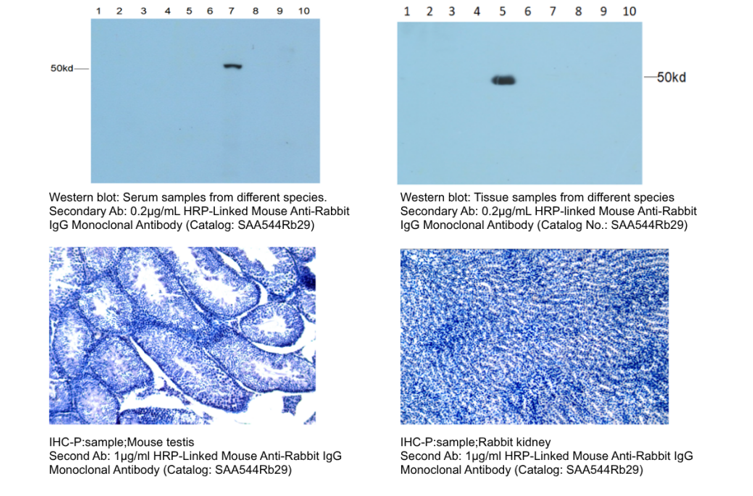
Cloud-Clone’s enzyme-conjugated secondary antibodies undergo rigorous cross-adsorption purification to minimize cross-reactivity with immunoglobulins from other species, effectively eliminating high background and non-specific bands. The product portfolio covers common experimental species including humans, rats, mice, rabbits, chickens, dogs and pigs, fully meeting research demands in basic medicine and life sciences.
(Figure 1: Cross-reactivity verification of Cloud-Clone secondary antibodies in WB and IHC)
2. Fluorescent-Labeled Secondary Antibodies: Optimal Tools for Intracellular Localization
Conjugated with classic fluorophores such as FITC, Cy3 and Cy5, fluorescent-labeled secondary antibodies enable intuitive visualization of antigens inside cells and tissues, ranking as the preferred reagent for Immunofluorescence (IF) and Immunocytochemistry (ICC). They support multi-color labeling, real-time imaging and co-localization observation, and are widely adopted in research on cell signaling pathways, subcellular localization and protein-protein interactions.
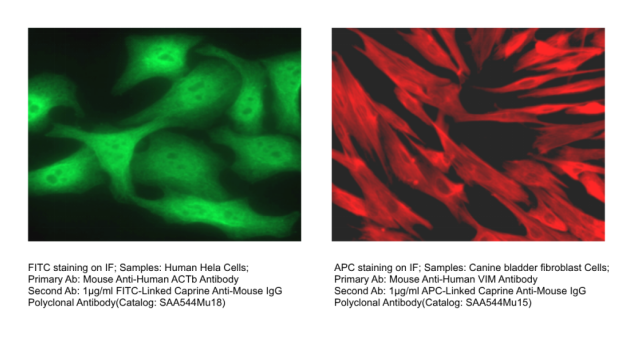
Cloud-Clone’s fluorescent secondary antibodies deliver high brightness, strong anti-photobleaching performance, outstanding specificity and stable batch consistency. Covering mainstream excitation wavelengths, they match various imaging systems. Highly purified manufacturing reduces non-specific binding, solving prevalent problems in fluorescence assays such as messy background, weak signals and blurry imaging, and laying a solid foundation for high-quality fluorescence microscopic observation.
(Figure 2: Application of Cloud-Clone fluorescent secondary antibodies in IF experiments)
3. Biotinylated Secondary Antibodies: High-Sensitivity Reagents for Trace Target Detection
Biotinylated secondary antibodies leverage the biotin-avidin system to achieve efficient signal amplification and greatly improve detection sensitivity, mainly applied to scenarios requiring strict detection limits, such as trace antigen detection and high-throughput screening of low-abundance targets. Key selection notes: these reagents must be used in tandem with avidin or streptavidin, and species/subtype matching with primary antibodies is mandatory.
High-quality biotinylated secondary antibodies from Cloud-Clone can detect targets at the picogram level, breaking technical bottlenecks in trace analysis and providing robust reagent support for research on low-abundance biomarkers.
Targeted Selection Tips for Four Classic Immunoassays
Different experiments impose disparate requirements on secondary antibodies. Cloud-Clone provides scenario-specific selection advice for four mainstream assays including WB, ELISA, IHC and IF:
Western Blot (WB) HRP-conjugated secondary antibodies are the primary option for their high chemiluminescence sensitivity and broad linear range. Biotin-streptavidin systems can be adopted to amplify signals for low-abundance proteins. Researchers must strictly match secondary antibody species with primary antibodies and select cross-adsorbed, highly specific variants to reduce non-specific bands and background interference.
Immunofluorescence / Immunocytochemistry (IF/ICC) Fluorescent-labeled secondary antibodies are mandatory for intracellular localization and multi-color imaging. Single fluorophores suffice for single-staining experiments; multi-color staining requires fluorophores with separated wavelengths, no spectral overlap and zero cross-reactivity, paired with anti-photobleaching mounting medium. High-specificity secondary antibodies drastically cut non-specific adsorption and improve imaging clarity and credibility.
Enzyme-Linked Immunosorbent Assay (ELISA) HRP-conjugated secondary antibodies are the first choice for indirect ELISA due to simple operation and stable performance, suitable for quantitative analysis of large batches of samples. Biotinylated secondary antibodies can be applied to sandwich ELISA to lower detection limits and enhance quantitative accuracy when higher sensitivity is needed.
Immunohistochemistry (IHC) Tissue sections feature complex matrices and abundant interfering substances. HRP or AP-conjugated secondary antibodies with high specificity and low background are recommended. Matching secondary antibodies to primary antibody subtypes avoids interference from endogenous enzymes and biotin, ensuring clear staining and accurate antigen localization.
Additional selection considerations include required sensitivity, sample types and detection equipment:
Standard qualitative assays adopt conventional labeled secondary antibodies;
Low-abundance target detection prioritizes high-sensitivity reagents;
Fluorescent secondary antibodies are not recommended if fluorescence imaging devices are unavailable;
Cross-adsorbed purified secondary antibodies are preferred for complex samples such as tissues and blood to reduce background noise.
The core logic of secondary antibody selection can be condensed into four steps: match the species and subtype of primary antibodies → confirm the experimental type → determine the labeling conjugate → balance sensitivity and specificity. With this standardized selection method and high-quality secondary antibodies from Cloud-Clone, researchers can avoid blind overspending on premium reagents, achieve precise, cost-effective selection, and guarantee reliable experimental results for subsequent research analysis.
All-Round Technical Support from Cloud-Clone to Accelerate Research Progress
With a complete industrial chain covering antigen preparation to quality control verification, Cloud-Clone specializes in research reagent development. All secondary antibodies pass strict tests for specificity, cross-reactivity and batch stability to guarantee consistent, reproducible experimental outcomes.
In terms of technical services, the company provides complete product manuals, standardized experimental protocols and one-on-one technical support to rapidly resolve reagent selection and experimental troubleshooting. Custom development services are also available for rare species, special labeling and customized purification schemes, catering to diverse research demands ranging from basic life science studies to translational medicine.
Thanks to stable performance and competitive pricing, Cloud-Clone secondary antibodies are widely used in life sciences, basic medicine, drug development and food safety sectors, supporting researchers to generate high-quality research data efficiently. Moving forward, Cloud-Clone will continue to advance antibody technology and deliver more professional, reliable and efficient reagents to drive research innovation and breakthroughs.
About Cloud-Clone Corp.
Cloud-Clone Corp. specializes in the research, development and production of immunoassay reagents and biomedical research solutions. Focusing on antibody engineering, multi-index detection technology and cross-platform product compatibility, the company delivers research tools supporting precision medicine and advanced biomedical research worldwide.
Its core product and service portfolio includes proteins, antibodies, ELISA kits, primary cells, multiplex cytokine assay kits and professional CRO services, covering diversified demands in biomedical research and related fields.
For more information, please visit the official website: www.cloud-clone.com
Contact Information
Tel: 001-832-538-0970; 0086-27-8425-9552
Email: mail@cloud-clone.com; sales@cloud-clone.us
Social Media Accounts:
LinkedIn: https://www.linkedin.com/company/cloud-clone-corp/
Instagram: https://www.instagram.com/cloudclonecorp2023/
TikTok: https://www.tiktok.com/@cloudclonecorp2026
SuKi Duan
CLOUD-CLONE CORP.WUHAN
+86 133 4986 4062
email us here
Visit us on social media:
LinkedIn
Instagram
TikTok
X
Legal Disclaimer:
EIN Presswire provides this news content "as is" without warranty of any kind. We do not accept any responsibility or liability for the accuracy, content, images, videos, licenses, completeness, legality, or reliability of the information contained in this article. If you have any complaints or copyright issues related to this article, kindly contact the author above.
